|
The
Better Burger Battle
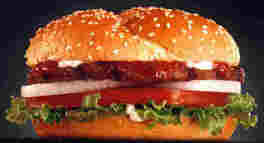 American
cuisine is identified around the world with this sandwich. We
have taken the idea of placing broiled, fried or even steamed
ground beef between bread or buns with a bewildering array of
condiments to the point where the hamburger may be the icon of
American food. In the Northeast, except for the steamed cheeseburger
(see below), there are no clear regions of how the hamburger is
treated but two of the claimants to the throne of the birthplace
of this sandwich are in the region so it needs to be included. American
cuisine is identified around the world with this sandwich. We
have taken the idea of placing broiled, fried or even steamed
ground beef between bread or buns with a bewildering array of
condiments to the point where the hamburger may be the icon of
American food. In the Northeast, except for the steamed cheeseburger
(see below), there are no clear regions of how the hamburger is
treated but two of the claimants to the throne of the birthplace
of this sandwich are in the region so it needs to be included.
In
1904 Davis and his wife went to the St. Louis World's Fair either
on his own or the townspeople took up a collection to send him
(there is no evidence for that claim, however). Whoever paid for
the trip, he was there since a reporter for the New York Tribune
wrote from the fair of a new sandwich called a hamburger, "the
innovation of a food vendor on the pike." The reporter did
not name the vendor but Athens resident Clint Murchison said that
his grandfather had strong memories of the sandwich in the 1880s
but remembered the innovator only as "Old Dave." Murchison
also had a large photograph of the midway at the 1904 fair with
"Old Dave's Hamburger Stand" marked apparently by his
grandfather. When Davis returned from the fair there were already
several cafes in Athens serving the sandwich and he went back
to firing pots in the Miller pottery works. Tolbert's investigation
proved that "Old Dave" was Fletcher Davis from Athens
(Tolbert 1983).
All
the claims of primacy have to deal with the question of how the
name was applied to the sandwich as well as the sandwich itself.
The story from Athens is that in town the sandwich had no name
but that it was given the name "hamburger" at the fair.
The Germans of St. Louis were principally from southern Germany
and enjoyed putting down northern Germans who, according to them,
were large eaters of ground meat, particularly raw. "So
the St. Louis Germans may have named the sandwich hamburger as
a derisive gesture toward the barbaric, ground-meat gobblers in
the city of Hamburg." (Kindree Miller, nephew of Fletch Davis,
reported in Tolbert's Texas).
The
promotional material for the 1991 hamburger festival in Athens
stated that the McDonald's Institute had proclaimed that town
the birthplace of the hamburger. While the McDonalds Corporation
does recognize the St. Louis World's Fair, 1904, as the place
where the first hamburger was served, the archives division was
unable to find any reference to the study cited by the Athens
newspaper (Wizniuk 1998). The person in charge of the hamburger
festival in Seymour, WI,, remembers the "study" as an
opportunity for school children to vote for the place of origin
and recalls that the Athens, TX, area seemed to be better organized
to get out the vote.
Hamburg,
NY
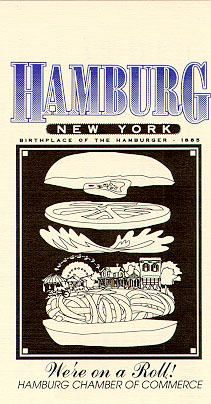 The
claim of Hamburg, NY, also relies heavily on oral history written
down long after the event. Two brothers, Charles and Frank Menches
from Stark County, OH, were travelling a circuit of fairs, race
meetings, and farmers' picnics in the early 1880s. They sold sandwiches
using a gasoline stove to fry the meat. The popular sandwiches
at these events were pork sausage, fried egg, fried liverwurst,
fried mush and fried peas porridge. The brothers decided to focus
on the pork sausage sandwich. In 1885 while selling at the Erie
County, NY, fair, also known as the Hamburg Fair for the county
seat, they ran out of pork sausage. The
claim of Hamburg, NY, also relies heavily on oral history written
down long after the event. Two brothers, Charles and Frank Menches
from Stark County, OH, were travelling a circuit of fairs, race
meetings, and farmers' picnics in the early 1880s. They sold sandwiches
using a gasoline stove to fry the meat. The popular sandwiches
at these events were pork sausage, fried egg, fried liverwurst,
fried mush and fried peas porridge. The brothers decided to focus
on the pork sausage sandwich. In 1885 while selling at the Erie
County, NY, fair, also known as the Hamburg Fair for the county
seat, they ran out of pork sausage.
At
this point the story gets a little confusing because two sources
make different claims. Kunzog, who talked with Frank Menches about
this in the 1920s, says that when they ran out of sausage they
approached a Hamburg butcher, Andrew Klein, who operated a slaughter
house and meat market. He was unable to furnish pork to them and,
since the weather was very hot, he did not want to do any
butchering for a small order. So he offered to chop up ten pounds
of beef.
After
forming patties and frying them they decided that a little brown
sugar would bring out the flavor. The legend contends that the
name was given for the town of Hamburg, NY, and had nothing to
do with the penchant for the people of Hamburg to eat ground or
finely chopped meat, as claimed in the Athens, TX, story.
A
local historian, Joseph Streamer, writing an "Out of the
Past" column in a local newspaper, The Sun, claimed
that the brothers had gotten the meat from Stein's
market, not Kleins, but in another column he noted that
Stein had sold the market in 1874; at that time Franch Menches
would have been only eleven years old. With the similarity of
"Stein" and "Klein" it is easy to see how
one could get confused but it sheds some doubt on the claim. Streamer
wrote approximately 200 of the small pieces in the paper and in
the one dealing with Stein's market no mention was made of the
hamburger invention. Nor do any of the centennial, sesquicentennial
or 175th anniversary volumes of Hamburg's history. The lack of
mention of the invention of the hamburger in the "official"
histories of some of these communities is consistent; all the
evidence seems to come from interviews long after the event.
New
Haven, CT
Several
sources, mostly Connecticut based, make a claim that the sandwich
was invented in 1895 in New Haven, CT. Local newspaper accounts
say that Louis Lassen, on emigrating from Denmark in 1880, sold
butter and eggs and then leased a lunch wagon in 1895. He first
specialized in a steak sandwich with thin slices of meat. He would
take the trimmings home and grind them up to serve as patties
or meat loaf to his family. Although some of the sources claim
1895 as the date for the sandwich, the Lassen family usually says
1900. Once when confronted with the Athens, TX, claim for Uncle
Fletch Davis, Kenneth Lassen, Louis' grandson, was quoted as saying,
"We have signed, dated and notarized affadavits saying we
served the first hamburger sandwiches in 1900. Other people may
have been serving the steak but there's a big difference between
a hamburger steak and a hamburger sandwich." (Lassen quoted
in Review Staff 1991). The sandwich was sold between pieces of
bread and soon became the bulk of Lassen's lunch business.
Louis'
Lunch is still selling their hamburgers from a small brick building
in New Haven. The sandwich is grilled vertically in antique
gas grills and served between pieces of toast rather than a bun.
Seymour,
WI
The
Seymour story has Charlie Nagreen serving the world's first hamburger
at the Seymour Fair of 1885, some five months before the Hamburg
claim. "Hamburger" Charlie supposedly decided to flatten
a meatball and place it between slices of bread. Speaking to the
Appleton (WI) Post Crescent in 1947, Nagreen claims
to have originated the use of the word also. The program printed
for the "Home of the Hamburger Celebration" in 1989
contained a reprinted account of the first Seymour Fair in 1885
and there was no mention Nagreen's invention (Anon. 1989).
 It
is clear from the Seymour story, however, that Charlie Nagreen
did continue to make hamburgers and was rather well known on the
local fair circuit until he was eighty years old. He was a busy
entrepeneur; his daughter said he also peddled Christmas trees,
party costumes, popcorn, fireworks and ice cream and also played
in Nagreen's Orchestra. The descriptions of Nagreen written by
people who knew him all spoke of his flair for promotion. "Hamburger
Charlie" passed away in 1951 still claiming to be the first
inventor of the hamburger. It
is clear from the Seymour story, however, that Charlie Nagreen
did continue to make hamburgers and was rather well known on the
local fair circuit until he was eighty years old. He was a busy
entrepeneur; his daughter said he also peddled Christmas trees,
party costumes, popcorn, fireworks and ice cream and also played
in Nagreen's Orchestra. The descriptions of Nagreen written by
people who knew him all spoke of his flair for promotion. "Hamburger
Charlie" passed away in 1951 still claiming to be the first
inventor of the hamburger.
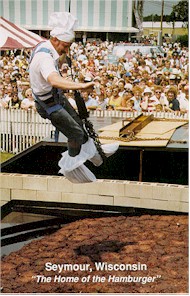
Seymour
has the most elaborate celebration and infrastructure of hamburger
history in the Hamburger Hall of Fame (they plan to build a hamburger-shaped
building) and an annual one day Burger Fest. In 1989 the world's
largest hamburger (5,520 pounds) was served at the festival. There
have been no challenges to the record so the annual big burger
now is only around 1,000 pounds. This festival also has several
competiive events around hamburgers - the hamburger relay and
the ketchup slide.
|
